Square Hammer Labs
SQUARE
HAMMER
LABS

Realtime learning for robots.

Everyone is building a better robot brain. We think robots get good after they ship.

SCROLL
00

EVERYONE IS BUILDING THE BRAIN.

THE LABSHIP IT
Physical Intelligence
more datamore computebigger model
Skild AI
more datamore computebigger model
Generalist
more datamore computebigger model
NVIDIA GR00T
more datamore computebigger model
Gemini Robotics
more datamore computebigger model
Figure
more datamore computebigger model
Tesla
more datamore computebigger model
1X
more datamore computebigger model

The industry's bet: build a better brain in the lab, train it once, ship it.

THE LABPICK OK
THE PART CHANGESMISS
THE LIGHT CHANGESMISS
THE GRIPPER WEARSMISS
In the lab~95%
In the factory~60%
Task success. Source: a16z, "The Physical AI Deployment Gap."

The facts that break a robot do not exist until it runs in a real factory. The factory changes faster than any brain is retrained.

01

ROBOTS GET GOOD AFTER THEY SHIP.

Building the brain
Learning in deployment
Where
The lab
The customer's factory
Data
Demonstrations, video
The robot's own signals, on its own failures
Clock
Months per training run
Milliseconds to minutes to fix
Scope
One model
Every brain, the controller, and the task plan
Proof
A benchmark
A fix that works on the next robot

Building the brain and learning in deployment are different problems. We chose the second one.

02

4.66 MILLION ROBOTS. IT SHOULD BE 100 MILLION.

Industrial robots at work, after fifty years
0.00M
+500K a year
International Federation of Robotics.
Where it should be
Today: 4.66M100M if deployment were not the limit. Our claim, not a forecast.
Each robot does one fixed task.Adding a task takes people nobody has.
Up to 50% of robotics engineering timegoes to diagnosing and fixing failures. Source: Grid Dynamics engineering leadership.
$8.5 trillion a year by 2030in revenue behind work nobody can hire for. Source: Korn Ferry. Robots are the only way to do that work.

The limit is not the robot. It is the people it takes to teach one task and keep it working.

03

THE BRAIN IS VERTICAL. LEARNING IS HORIZONTAL.

Each brain lives in its own column. Each factory sees only its own fleet. Learning in deployment runs under every brain and above every factory. That is our layer.

Up: the robot's signals and video, every runDown: validated fixes, in minutesDown: weights, once
04

THE ROBOT LEARNS ON THE JOB.

Runs todayBuilt this round

Fine-tune to task

THE CUSTOMER'S BRAIN+TASK DATA=TUNED TO THE TASK

The customer picks the brain. The packaged fine-tune flow is this round.

Deploy behind gates

SIMULATION
REGRESSION
STAGED

Nothing ships without a pass. Staged release is this round.

Capture

Torque, current, vacuum, video. Versioned.

Diagnose
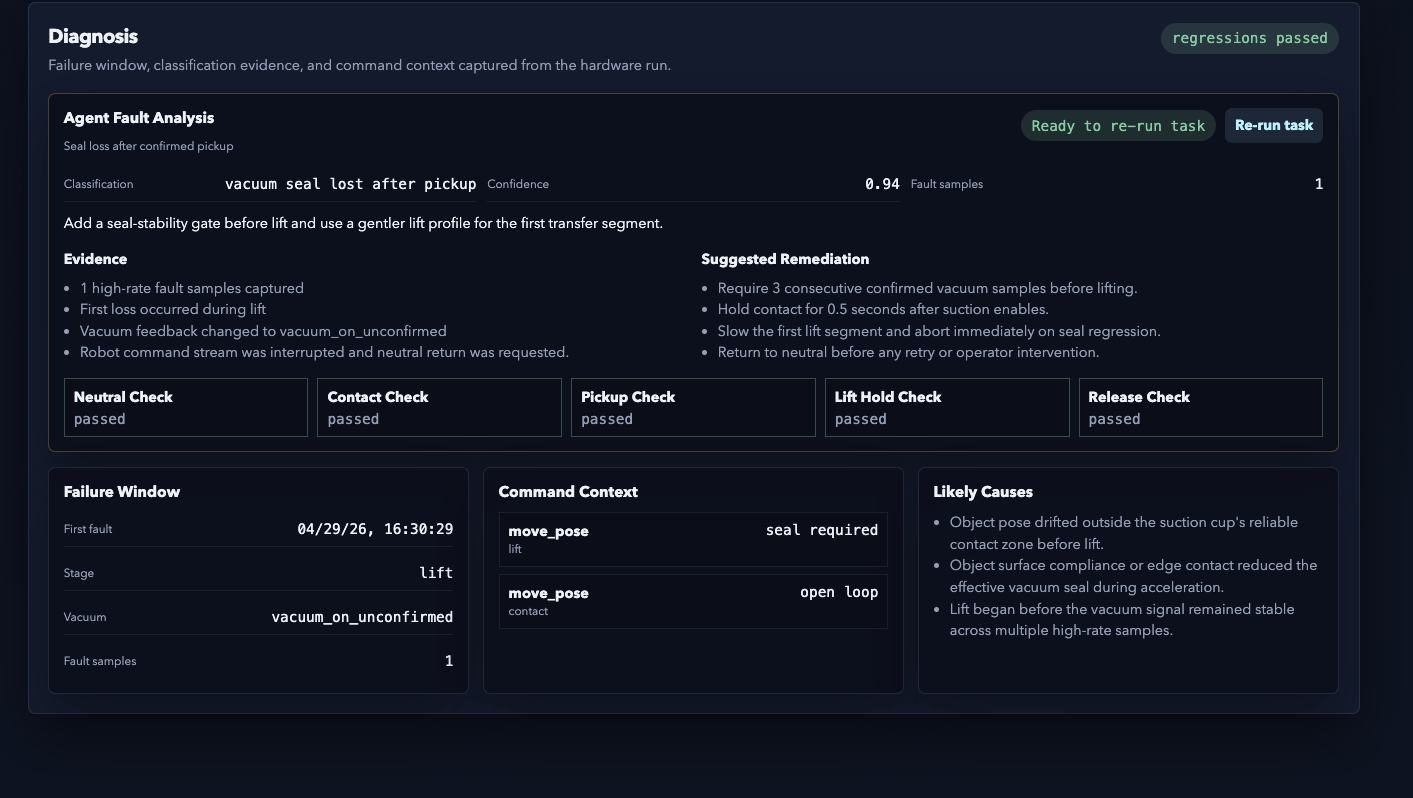
The diagnosis screen from a real hardware run: vacuum seal lost after pickup, 0.94 confidence, regressions passed.

Signal first. Camera second. Real run: vacuum seal lost after pickup, 0.94 confidence.

Choose the fix or the retrain

PARAMETERCODEDATAFINE-TUNE

Dozens of ways to fix it. Pick one.

Validate
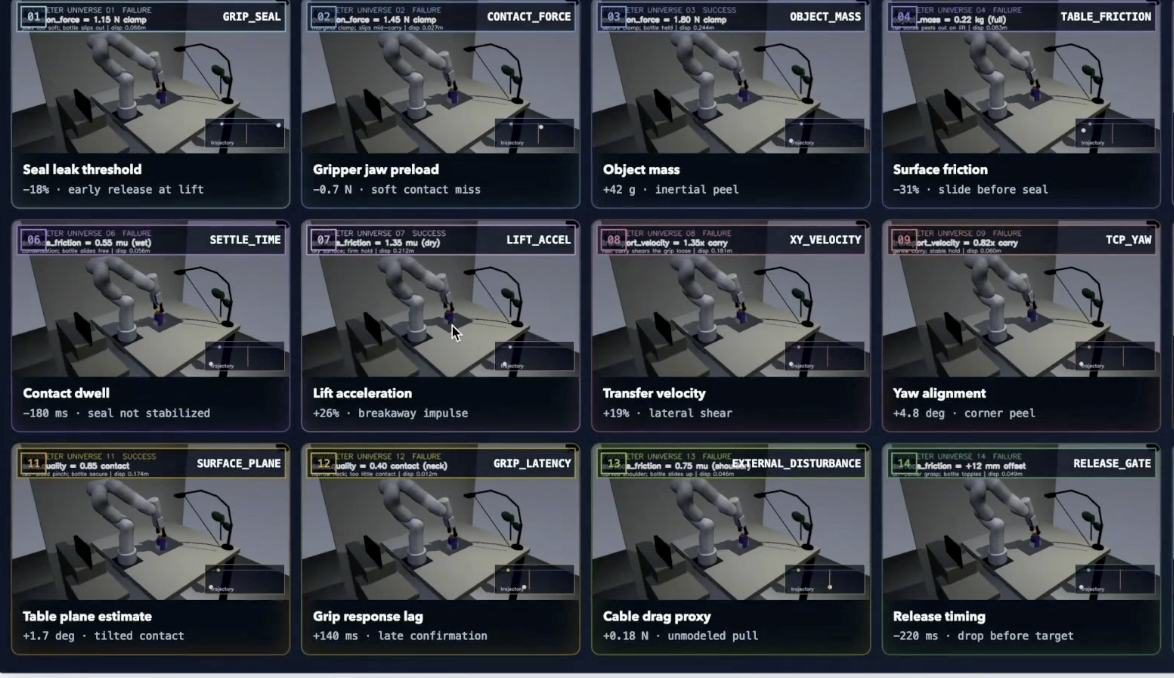
Twelve simulated variations generated from one failure. Each changes one physical parameter.

Twelve variations from one failure. 14 of 14 simulated cases pass.

Push to fleet

Gradually, behind regression gates. Fleet rollout is this round.

Learn

LIBRARY

The fix is saved today. A library every robot shares is this round.

FIRST FAILURE · 4 model calls · 3 generated candidates

The first time, the system works it out: why the robot failed, which fix, and proof the fix holds.

NEXT ROBOT · 82 g (was 80) · friction 0.85 (was 1.0) · offset 0.5 mm

FIRST FAILURE

4 model calls
3 generated candidates
78.4K tokens

NEXT ROBOT

1 model call
0 new candidates
15.2K tokens

Measured in one session on different cases, not a same-case benchmark.

A fix that works on the next robot.

Before
With Square Hammer
Train
Weeks. The method by trial and error. The data by capture, simulation, or teleop.
15 minutes to 1 dayThe library recommends the method and the data.This round
Deploy
Days. Hand-tuned on site until it runs.
About 1 hourBehind simulation and regression gates.This round
Capture
Days. Engineers read logs and rebuild the simulation by hand.
About 5 secondsFrom signals and video. Versioned.
Diagnose
Days. From logs and video, by hand.
About 1 minuteThe physics and video engine plus the library.
Fix
Days. Edit code, rerun on the real robot.
1 minute to 1 hourRanked repairs and fine-tunes.
Validate
No test suite. Old tasks break silently.
About 5 minutesIn simulation, with variations, so the fix holds.
Push to fleet
Days. One robot at a time, by hand.
About 1 hourGradually, behind regression gates.This round
Learn
The lesson is lost.
KeptFor every robot.This round

Ranges observed in customer engagements and our own runs. Start: the failure is detected. End: a validated change is ready for release. Dashed: built this round.

Days become minutes at every step. That is the fix clock.

05

THE CAMERA SEES THE DROP.

The signals see the cause.

CONTROLLER: LIFT FAILED THE CAMERA SHOWS THE DROP

Recorded on our xArm 5. Lower trace: one joint torque, redrawn. Amber: the controller-confirmed failed lift.

The camera shows that the lift failed. The robot's own signals show what happened at each joint while it failed. That is how we know which step to change.

SQUARE HAMMER0%

CAMERA-ONLY AGENT0%

On 200 failures Grid Dynamics chose, in their simulator, we solved or escalated 74%. Their camera-only agent solved none of the 12 held-out failures.

Grid Dynamics evaluation, 2026. Escalated means referred to a person with a diagnosis.

BEFORE · LIFT FAILEDAFTER · 15 MM DEEPER · PICKUP COMPLETE

The fix was found in simulation and confirmed on the real arm. Same jaw command. Same speed.

One paired trial on our xArm 5. Not a reliability estimate.

"Even at 96.4% autonomy, one action in twenty-eight still needs a human."

Physical Intelligence partner program, 2026

"I spend all my time just trying to figure out why the robot failed."

Head of Physical AI, NVIDIA Inception
06

A BETTER BRAIN IS NOT A BETTER ROBOT.

A failure can live in any layer of the robot. The brain vendor fixes one layer, overnight. We fix the layer that failed, in minutes, under any brain.

07

THE PILOTS. THE PEOPLE.

We are running a pilot with Amazon Robotics' manipulation science team.
Setting up a pilot.
Signed, priced letter of intent.
Bradford Stephens
Bradford StephensCofounder, CEO

Built Salesforce's Hyperforce. Ran platform engineering at ServiceTitan through its IPO.

SalesforceServiceTitanMicrosoft
Nick Kypreos
Dr. Nick KypreosCofounder, Chief AI Officer

PhD, particle physics. ML for the Large Hadron Collider at CERN. Amazon, Meta, Apple.

CERNAmazonMetaApple
Damion Shelton
Damion SheltonAdvisor

Cofounder and chairman, Agility Robotics.

Agility Robotics
Hyun Joe Jeong
Hyun Joe JeongRobotics research, advisor

PhD robotics researcher, CMU Robotics Institute. NSF Graduate Research Fellow. CoRL 2026, IROS 2025.

Carnegie Mellon University Robotics Institute
Zach Greenberger
Zach GreenbergerAdvisor

CEO, Empiric Earth. Formerly Nexar.

Also robotics and infra engineers from
TwitterBoundarySalesforceWinklevoss CapitalCarnegie Mellon University Robotics Institute

Learning in deployment is fast ML on high-rate signals plus systems that run at fleet scale. This team has built both, from CERN to the cloud.

Hiring on close: the five people who run the pilots. Three in ML and control, two in robotics and forward deployment. Interviews are in progress.

08

WE SELL TO THE TEAMS THAT DEPLOY ROBOTS.

Who buys

Integrators, arm makers, and fleet operators. The buyer runs deployment and owns the software loop from training through repair.

How we charge

Per robot per month, or a site license for a fleet. Direct sales. A forward-deployed engineer first; then the repeatable parts become product.

Where we start

Repeatable tasks in one vertical, where the same failures recur: precision manufacturing; pick, place, and sort; palletizing. Repeat failures make the library compound fastest.

One taskOne lineOne siteThe fleetThe next model version
159 sthe first fix in a failure family
under 45 sthe repeat, from the library

Every fix cheapens the next. Customers share failure classes, not process data. Customer data is isolated by default. Cross-customer learning runs under signed data rights.

The number we run on: tasks in production per deployment engineer.

09

WHAT THIS ROUND BUILDS.

MONTHS 0 TO 6

  • Team hired.
  • The full loop runs end to end on one customer task.
  • First research result published: signals vs video on the hard cases.

MONTHS 6 TO 12

  • Method selection runs on pilot data.
  • Pilot results in hand.
  • Priced round with the strategics.

MONTHS 12+

  • The library covers a measurable set of failure classes across pilots.
  • Contracts follow the pilots that pass.
$6M SAFE

Funds the research team and the Amazon pilot. The team is in place four weeks after close.

Two strategic investors are in diligence and will decide after their pilots, for a priced round in Q1.

Where the money goes
  1. Core ML and control systems. Diagnosis, repair selection, validation, the learning loop.
  2. Robotics and forward-deployed engineers. Customer systems, integrations, field reliability.
  3. Compute, simulation, and data. Replay, evaluation, training, infrastructure.
  4. Hardware and test capacity. Robot cells, sensors, partner deployments.
  5. Security, IP, legal, and operations.
  6. A reserve for schedule and technical risk.
bradford@squarehammerlabs.com
SQUARE
HAMMER
LABS